Sheet Metal vs. Structural Steel Fabrication: Which Process Is Right for Your Project?
Material selection and fabrication process go hand in hand — and few decisions shape a product’s cost, weight, lead time, and manufacturability more than choosing between sheet metal vs. structural steel fabrication. Both are widely used across industrial, commercial, and defense applications, but they solve fundamentally different engineering problems. Picking the wrong one doesn’t just affect the part — it can ripple through your entire production program.
At AP Precision Metals, we’ve been fabricating precision metal components for OEMs for over 20 years from our San Diego facility. Our capabilities span 20-gauge thin sheet through 1.5-inch medium plate, with integrated cutting, welding, finishing, and assembly under one roof. This guide breaks down how each fabrication method works, where each one excels, how they compare on cost and lead time, and how to make a confident decision for your specific application.
Sheet Metal and Structural Steel Are Built for Different Load and Form Requirements
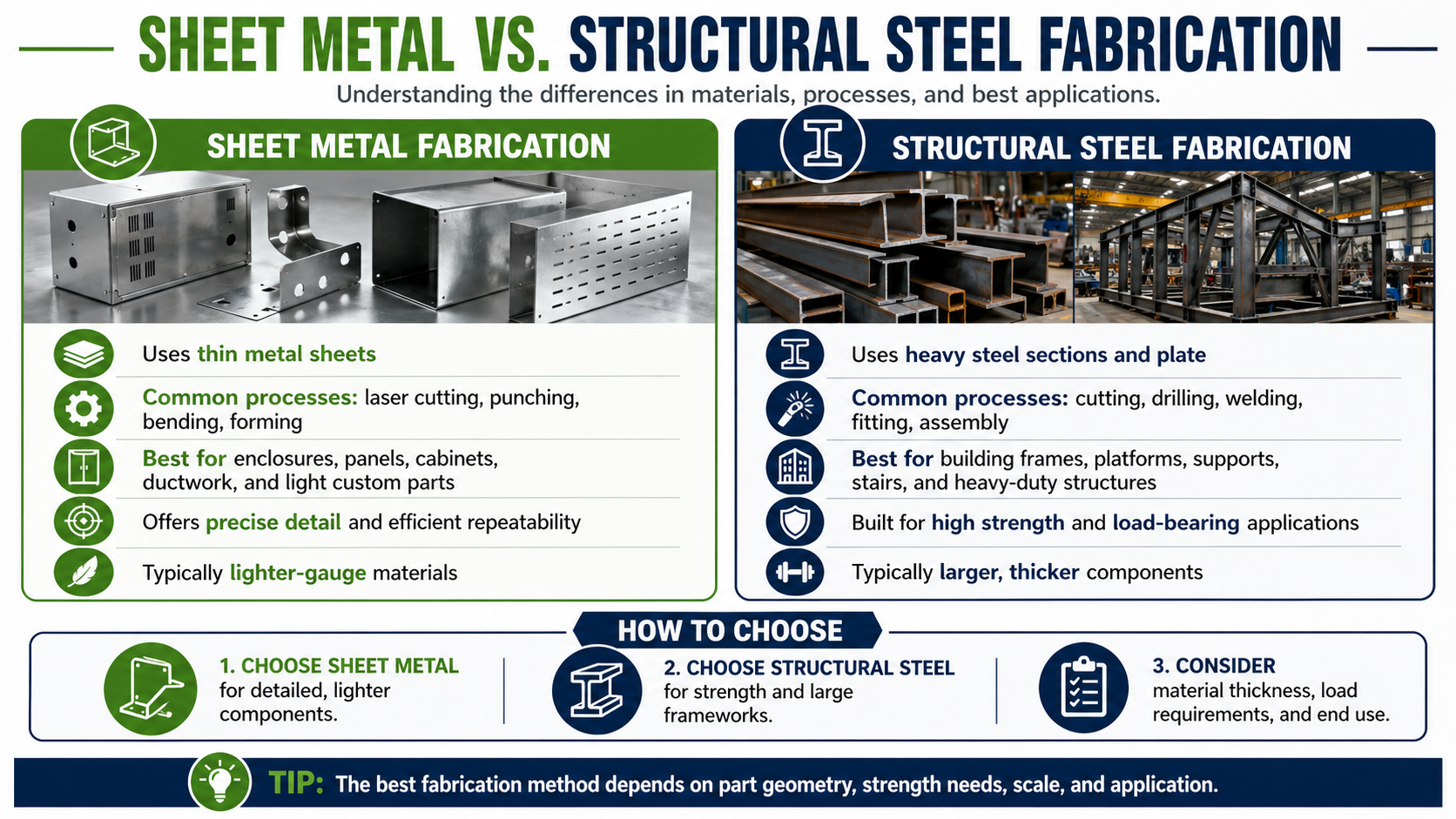
The clearest way to understand the difference between these two fabrication approaches is to think about what each one is engineered to do. Sheet metal fabrication is optimized for precision geometry, tight tolerances, and weight efficiency — producing enclosures, chassis, brackets, panels, and formed components from thin, flat stock. Structural steel fabrication is optimized for load-bearing capacity and rigidity — producing frames, supports, platforms, and infrastructure from heavier rolled profiles like I-beams, channels, angles, and hollow structural sections.
These aren’t competing methods fighting for the same applications — they’re tools designed for different jobs. The challenge is that some projects sit near the boundary, where plate fabrication, heavy sheet work, or welded assemblies could reasonably go either direction. That’s where understanding the trade-offs in detail becomes valuable.
How Sheet Metal Fabrication Works — and Where It Excels
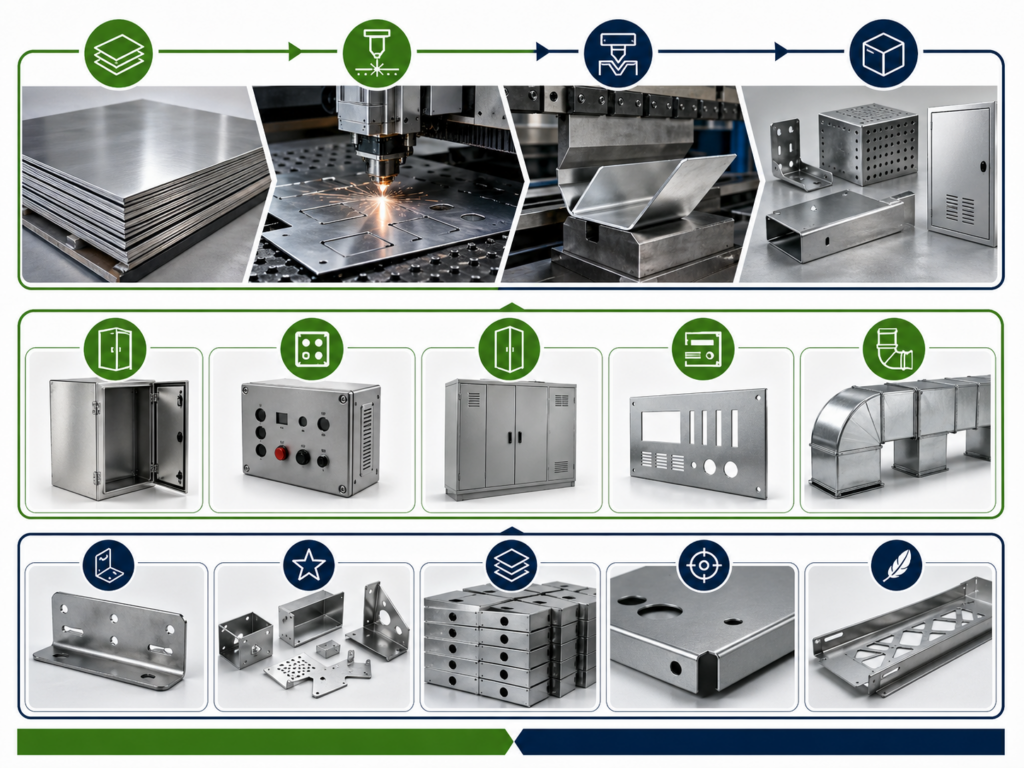
Sheet metal fabrication starts with flat stock — coil or sheet — and transforms it into three-dimensional parts through a sequence of subtractive and forming operations. The core process steps include cutting, forming, joining, and finishing.
Primary Sheet Metal Processes
- Laser cutting: 2D fiber lasers cut flat profiles with high precision and minimal material waste. Ideal for complex geometries, tight tolerances, and high-volume production. AP Precision Metals uses industry-leading fiber laser technology capable of processing a wide range of alloys and thicknesses.
- CNC punching: Punch presses stamp holes, slots, louvers, and forms into sheet metal at high speed. Economical for high-volume flat parts with repetitive features.
- Press brake bending: Bends flat blanks into angles, channels, and complex folded profiles. Tolerances of ±0.5° to ±1° on bend angle are standard; tighter angles are achievable with tooling designed for specific applications.
- Welding: MIG, TIG, spot, and robotic weld cells join sheet metal components into assemblies. Robotic welding improves consistency and reduces labor cost on high-volume assemblies.
- Hardware insertion: PEM fasteners, standoffs, and studs are pressed into sheet metal to create threaded attachment points without separate nut hardware.
Where Sheet Metal Fabrication Excels
- Electronic enclosures, equipment chassis, and rack-mount panels
- HVAC components, air handling equipment, and ductwork
- Electrical cabinets, junction boxes, and bus bar housings
- Defense and military electronics packaging
- Solar and energy storage system enclosures
- Industrial equipment guards, covers, and structural brackets
- OEM sub-assemblies requiring integration of formed parts, hardware, and finishing
Sheet metal fabrication is particularly well-matched to production volumes in the 100 to 10,000-unit range — the mid-to-high volume sweet spot where AP Precision Metals has built its manufacturing systems. At these volumes, the combination of automated laser cutting, CNC punching, and robotic welding delivers pricing competitive with stamped parts, without the tooling investment that stamping requires.
How Structural Steel Fabrication Works — and Where It Excels
Structural steel fabrication begins with mill-rolled steel profiles — I-beams (wide flange), HSS tube, angle iron, channels, and flat bar in heavier gauges — and cuts, drills, and welds them into load-bearing assemblies. The process is less about precision forming and more about structural integrity, joint strength, and assembly fit-up.
Primary Structural Steel Processes
- Sawing and plasma/flame cutting: Structural profiles are cut to length using automated bandsaws or plasma cutting tables. Tolerances are typically looser than precision sheet metal work — ±1/16 inch is common for structural cuts.
- Drilling and punching: Holes for bolted connections, anchor bolts, and through-fasteners are drilled or punched using ironworkers or CNC drill lines.
- Heavy welding: Fillet welds, groove welds, and full-penetration welds join structural members. AWS-certified welders are typically required, and weld inspection (visual, ultrasonic, or radiographic) is common on load-bearing joints.
- Shot blasting and coating: Structural assemblies are typically abrasive blasted and primed or painted to prevent corrosion, especially for outdoor or industrial environments.
Where Structural Steel Fabrication Excels
- Building frames, mezzanines, and structural platforms
- Industrial equipment skids and base frames
- Conveyor structures, overhead crane runways, and support gantries
- Infrastructure fabrication — bridges, towers, and utility structures
- Heavy machinery frames and weldments
- Mining, oil and gas, and heavy industrial applications
Which Process Is More Cost-Effective for Your Project?
Cost comparisons between sheet metal and structural steel fabrication are only meaningful when both are genuinely viable options for the application. For most precision components in the electronics, energy, and defense sectors, sheet metal is the natural fit and the cost conversation is really about process optimization within that method. For heavy load-bearing infrastructure, structural steel isn’t competing with sheet metal — it’s the only appropriate tool.
When the application genuinely sits at the boundary — a heavy weldment that could be designed in plate or structural profiles, for example — these cost drivers favor each approach:
Factors That Favor Sheet Metal on Cost
- Automated cutting and forming processes reduce labor cost per part at volume
- Lighter raw material weight reduces material cost and shipping cost
- No tooling investment required for laser-cut and press-brake work
- Integrated finishing (powder coat, Linex) in-house at AP Precision eliminates subcontract markup
- Faster cycle times on formed parts vs. heavy weldments
Factors That Favor Structural Steel on Cost
- Raw material cost per pound is lower for structural carbon steel vs. precision sheet alloys
- Simpler joint geometries require less setup time on basic cut-and-weld assemblies
- Lower inspection requirements on non-critical structural work
- Design flexibility — field modifications and adjustments are easier on bolted structural assemblies
Side-by-Side Comparison: Sheet Metal vs. Structural Steel Fabrication
| Factor | Sheet Metal Fabrication | Structural Steel Fabrication |
|---|---|---|
| Material thickness | 20 gauge – ~0.25 inch (6 mm) | Typically 0.25 inch and above |
| Primary forms | Flat sheet, coil stock | I-beams, channels, angles, HSS tube |
| Core processes | Laser cutting, punching, press brake, welding | Sawing, drilling, heavy welding |
| Dimensional tolerance | Tight — ±0.005″ to ±0.030″ typical | Looser — ±1/16″ to ±1/8″ typical |
| Weight | Light to medium | Medium to very heavy |
| Best for | Enclosures, panels, brackets, OEM sub-assemblies | Frames, platforms, load-bearing infrastructure |
| Volume suitability | Excellent for mid-to-high production volume | Better suited for one-off or low-volume projects |
| Finishing options | Powder coat, plating, anodizing, Linex | Primer, paint, galvanizing, shot blast |
| Automation potential | High — laser, punch, robotic weld | Moderate — some CNC drilling and plasma |
| Typical industries | Electronics, defense, energy, HVAC, industrial | Construction, infrastructure, heavy industry |
Can a Single Project Use Both Sheet Metal and Structural Steel?
Yes — and in complex industrial and defense programs, this is more common than the either/or framing suggests. A large equipment enclosure might use a structural steel base frame for rigidity and load-bearing capacity, with sheet metal panels, covers, and internal brackets fabricated separately and assembled onto the frame. An industrial skid might use structural steel for the primary frame and sheet metal for cable management trays, junction boxes, and access doors.
When a project spans both methods, the supplier relationship matters as much as the technical capability. Working with a fabricator who understands both processes — even if they specialize in one — makes coordination, fit-up, and schedule management significantly easier. At AP Precision Metals, our capabilities cover fabrication from thin sheet through medium plate, welding across a range of joint types and alloys, and in-house finishing — giving OEM customers a single source for the fabricated components that make up the majority of most equipment programs.
Frequently Asked Questions: Sheet Metal vs. Structural Steel Fabrication
What is the main difference between sheet metal and structural steel fabrication?
Sheet metal fabrication works with thin, flat stock using cutting, bending, punching, and welding to produce enclosures, brackets, panels, and formed components. Structural steel fabrication works with heavier profiles — I-beams, channels, and angles — to produce load-bearing frames and infrastructure. The right choice depends on whether your application requires precision geometry and weight efficiency or raw structural strength.
Is sheet metal fabrication cheaper than structural steel fabrication?
For precision components and enclosures at production volume, sheet metal fabrication is typically more cost-effective. Automated cutting and forming processes lower per-part labor cost, and lighter raw material reduces both material and shipping expense. Structural steel carries higher per-unit cost due to heavier material, more manual labor, and specialized welding requirements — but cost comparisons are only meaningful when both methods are genuinely viable for the application.
What industries typically use sheet metal fabrication?
Sheet metal fabrication is widely used in electronics and electrical equipment, HVAC, telecommunications, defense, energy, medical devices, and industrial equipment manufacturing. It is the preferred method for enclosures, chassis, brackets, panels, and any application where weight, precision, and high-volume repeatability are priorities.
Can the same fabrication shop handle both sheet metal and structural steel work?
Some full-service fabricators handle both, but capabilities vary. Sheet metal shops are set up for precision forming of thinner gauges using laser cutters, press brakes, and punch presses. Structural steel work requires different equipment — ironworkers, heavy welding cells, and material handling for large profiles. AP Precision Metals specializes in sheet metal and light-to-medium plate fabrication from 20GA through 1.5-inch plate.
What thickness range is considered sheet metal in fabrication?
Sheet metal generally refers to stock ranging from approximately 0.5 mm (24 gauge) up to about 6 mm (0.25 inches) thick. Stock thicker than 6 mm is typically classified as plate. This boundary matters for process selection, tooling requirements, and the fabrication equipment required to produce the part at tolerance.
Match the Process to the Problem — and the Rest Follows
Sheet metal and structural steel fabrication aren’t rivals — they’re purpose-built tools for different engineering challenges. Sheet metal wins on precision, weight efficiency, and production volume economics. Structural steel wins on raw load-bearing capacity and simple, heavy construction. Understanding that distinction early in the design process saves time, budget, and rework across the entire program.
If your project calls for precision sheet metal or medium-plate fabrication, AP Precision Metals is ready to put over 20 years of OEM manufacturing experience to work for you. From laser cutting and CNC punching through robotic welding, powder coating, and assembly, we build complete fabricated components under one roof in San Diego. Reach out to our team at (619) 628-0003, email [email protected], or request a quote online to get started.