
Choosing Alloy for Environments: How to Match the Right Metal to Every Exposure Condition
An alloy that performs flawlessly in a temperature-controlled warehouse can corrode to failure in months at a coastal installation, and a metal that thrives in seawater may become dangerously brittle in a cryogenic storage facility. Choosing alloy for environments is the engineering discipline of matching a metal’s chemical composition, mechanical properties, and corrosion resistance profile to the specific physical, chemical, and atmospheric conditions it will face throughout its service life. Get this decision right and you build something that lasts decades with minimal maintenance. Get it wrong and you inherit a cycle of premature failures, emergency replacements, unplanned downtime, and escalating costs that dwarf whatever you saved by selecting the cheaper material upfront. Whether you’re specifying structural steel for a coastal bridge, process piping for a chemical plant, hardware for a food processing line, or architectural cladding for a high-rise in a polluted urban center, the environment your alloy will live in should drive the selection — not the other way around.
This guide breaks down the major service environment categories, identifies the alloys that perform best in each, explains the degradation mechanisms you’re defending against, and gives you a practical framework for making material decisions that hold up for the long term.
Why Environment Is the First Variable, Not the Last
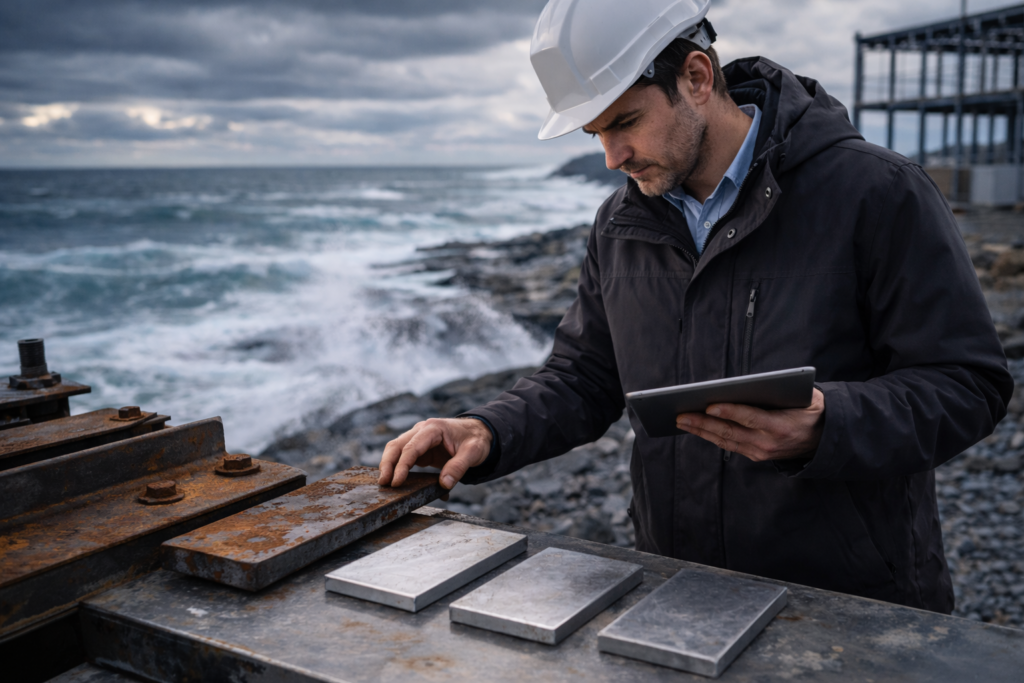
Too many projects begin with a material already in mind — usually whatever was used on the last job or whatever the fabricator has in stock — and then work backward to justify it for the current application. This approach works until it doesn’t, and when it fails, it fails expensively.
Every service environment presents a unique combination of stressors: temperature range, humidity, chemical exposure, UV radiation, mechanical loading, abrasion, biological growth, electrical currents, and atmospheric pollutants. An alloy’s resistance to these stressors is determined by its specific chemistry and microstructure, not by broad category labels. “Stainless steel” is not a single material — it’s a family of over 150 distinct grades, each engineered for different conditions. Saying you need “stainless” for a project is like saying you need “medicine” for an illness. The specificity matters.
Starting with the environment forces you to define what the metal actually needs to survive, which narrows the field to alloys with proven performance under those exact conditions. Everything else — cost, availability, fabricability, aesthetics — is evaluated within that shortlist, not before it.
Marine and Coastal Environments
Saltwater and salt-laden air are among the most aggressive corrosion accelerators any metal can face. Chloride ions in seawater attack the passive oxide layers that protect many alloys, triggering pitting corrosion, crevice corrosion, and stress corrosion cracking — all of which can progress beneath the surface without visible warning until structural integrity is already compromised.
Best Alloy Choices
316L Stainless Steel is the baseline specification for marine-grade stainless. The addition of molybdenum (2–3%) gives it significantly better chloride pitting resistance than the more common 304 grade. The “L” designation indicates low carbon content, which reduces susceptibility to sensitization and intergranular corrosion in welded assemblies. For hardware, fasteners, railings, and structural components in coastal buildings and marine vessels, 316L is the most widely specified alloy.
Duplex Stainless Steels (such as 2205) offer roughly twice the yield strength of 316L with superior resistance to chloride stress corrosion cracking. They’re increasingly specified for offshore platforms, desalination plants, and subsea piping where both mechanical strength and corrosion resistance are critical.
Copper-Nickel Alloys (90/10 and 70/30 Cu-Ni) are the traditional choice for seawater piping, heat exchangers, and marine condensers. Their natural resistance to biofouling — the attachment of barnacles, algae, and other marine organisms — gives them a functional advantage that stainless steels lack.
Titanium (commercially pure and Grade 5 Ti-6Al-4V) is virtually immune to seawater corrosion and is used in the most demanding marine applications: submarine components, offshore heat exchangers, and naval propeller shafts. Its cost limits use to applications where failure consequences justify the premium.
What to Avoid
Standard carbon steel corrodes rapidly in marine environments, even with paint systems, and requires constant maintenance. 304 stainless steel, despite its general corrosion resistance, is prone to pitting and crevice attack in chloride-rich conditions and should not be substituted for 316L in true marine or coastal service.
Chemical Processing Environments
Chemical plants expose metals to acids, alkalis, solvents, and reactive compounds at elevated temperatures and pressures — often in combination. The corrosion mechanisms are diverse and application-specific, making material selection one of the most consequential engineering decisions in plant design.
Best Alloy Choices
904L Stainless Steel handles dilute sulfuric acid, phosphoric acid, and acetic acid environments well and is more cost-effective than nickel-based superalloys for moderate chemical exposure.
Hastelloy C-276 is one of the most versatile corrosion-resistant alloys in existence. It resists pitting, crevice corrosion, and stress corrosion cracking across a wide range of aggressive chemicals, including hydrochloric acid, sulfuric acid, chlorine gas, and mixed acid environments. It’s a workhorse in chemical reactors, scrubbers, and flue gas desulfurization systems.
Inconel 625 combines exceptional corrosion resistance with high-temperature strength, making it the preferred alloy for environments where chemical attack and thermal stress coexist — such as waste incineration systems and chemical reactor vessels operating above 1,000°F.
Monel 400 (a nickel-copper alloy) excels in hydrofluoric acid service, seawater, and alkaline environments. It’s a standard material for valves, pumps, and piping in HF alkylation units in petroleum refining.
The Compatibility Trap
No alloy is universally chemical-resistant. An alloy that handles sulfuric acid brilliantly may fail catastrophically in hydrochloric acid at the same concentration and temperature. Always verify material compatibility against the specific chemicals, concentrations, temperatures, and flow conditions of your process — not against general corrosion resistance charts, which can be dangerously oversimplified.
High-Temperature Environments
Prolonged exposure to elevated temperatures introduces degradation mechanisms that don’t exist at ambient conditions: oxidation scaling, creep deformation, thermal fatigue, and high-temperature corrosion from sulfur, carbon, and other reactive species in the atmosphere.
Best Alloy Choices
310 Stainless Steel provides excellent oxidation resistance up to approximately 2,000°F (1,100°C) and is widely used for furnace components, kiln linings, heat treatment baskets, and radiant tubes.
Inconel 600 and 601 offer outstanding high-temperature oxidation and carburization resistance. They’re standard selections for process heaters, petrochemical reformer tubes, and thermal processing equipment.
Haynes 230 handles extreme thermal cycling without cracking — a property that makes it valuable for gas turbine combustion cans, aerospace hot-section components, and industrial burner systems where temperatures fluctuate rapidly and repeatedly.
For structural applications at moderately elevated temperatures (up to roughly 800°F), chromium-molybdenum steels (such as ASTM A387 Grade 11 and Grade 22) provide good creep resistance at a fraction of the cost of nickel superalloys.
The Creep Factor
Unlike corrosion, which removes material, creep permanently deforms it. Components operating under sustained mechanical load at high temperatures will slowly stretch, sag, and distort over time — even at stress levels well below their room-temperature yield strength. Alloy selection for high-temperature structural service must account for creep rupture data, not just static strength values. This is a nuance that gets missed when engineers specify alloys based on room-temperature datasheets alone.
Cryogenic and Low-Temperature Environments
At the opposite end of the thermal spectrum, extreme cold introduces ductile-to-brittle transition behavior in many metals. Alloys that are tough and ductile at room temperature can become glass-like and fracture-prone at cryogenic temperatures, failing without warning under impact or shock loading.
Best Alloy Choices
304L and 316L Austenitic Stainless Steels retain excellent toughness down to liquid nitrogen temperatures (−320°F / −196°C) and are the most commonly specified alloys for cryogenic storage vessels, LNG piping, and cold-box heat exchangers.
9% Nickel Steel (ASTM A553) is the standard material for large-scale LNG storage tanks. It provides adequate toughness at −260°F (−162°C) at significantly lower cost than full austenitic stainless construction.
Aluminum Alloys (particularly 5083 and 6061) maintain ductility at cryogenic temperatures and are used extensively in aerospace cryogenic fuel systems, laboratory dewars, and portable cryogenic containers where light weight is advantageous.
What to Avoid
Carbon steel and most ferritic and martensitic stainless steels undergo a ductile-to-brittle transition at temperatures well above cryogenic range. Standard A36 structural steel, for example, can become dangerously brittle at temperatures that many northern climates reach during winter cold snaps. Any application involving sub-zero service temperatures demands a formal impact toughness evaluation — typically Charpy V-notch testing — at the minimum expected operating temperature.
Outdoor Atmospheric and Urban Environments
Not every environment is as extreme as a chemical reactor or an offshore platform. Ordinary atmospheric exposure — rain, humidity, temperature cycling, UV radiation, and urban pollutants like sulfur dioxide and nitrogen oxides — still degrades metals over time, and alloy selection determines whether that degradation is cosmetic or structural.
Corten Steel (ASTM A588) develops a protective rust patina that stabilizes and protects the underlying steel from further corrosion. It’s widely used for bridges, building facades, outdoor sculpture, and infrastructure where a maintenance-free weathered aesthetic is desired. Note that Corten does not perform well in persistently wet environments or in contact with saltwater — the patina requires wet-dry cycling to form properly.
Galvanized Steel — carbon steel coated with a sacrificial zinc layer — is the most cost-effective corrosion protection strategy for structural steel, fencing, utility poles, and highway guardrails in atmospheric service. Hot-dip galvanizing provides 30 to 75+ years of protection depending on the environment’s aggressiveness.
Aluminum (particularly the 6000 series) offers permanent corrosion resistance without coatings and is the standard for architectural curtain wall framing, window systems, and exterior trim in commercial construction.
A Practical Decision Framework
When evaluating alloys for a specific environment, work through these five questions in order:
What is the primary degradation threat? Identify whether the dominant risk is corrosion (and what type), high-temperature oxidation, embrittlement, wear, or some combination.
What are the operating temperature extremes? Both the steady-state range and any thermal cycling or shock conditions affect alloy performance and limit your options.
What is the required service life? A 5-year equipment cycle tolerates different material economics than a 50-year infrastructure installation.
What are the fabrication and joining requirements? Some high-performance alloys require specialized welding procedures, post-weld heat treatment, or non-standard machining that can significantly increase fabrication costs.
What does the total cost of ownership look like? A cheaper alloy that requires recoating every three years and replacement every ten may cost far more over a 30-year service window than a premium alloy that requires nothing.
Frequently Asked Questions
How do I choose the right alloy for a specific environment?
Start by identifying the primary degradation mechanisms your material will face — corrosion type, temperature extremes, chemical exposure, and mechanical loading. Then narrow your selection to alloys with documented resistance to those specific conditions. Verify compatibility using published corrosion data, manufacturer technical bulletins, or testing under simulated service conditions.
What is the best alloy for saltwater and marine environments?
316L stainless steel is the most widely specified marine-grade alloy for general applications. For higher-strength requirements or more severe chloride exposure, duplex stainless steels (such as 2205) or copper-nickel alloys offer superior performance. Titanium provides the highest resistance but at a significant cost premium.
Can I use 304 stainless steel outdoors?
304 stainless steel performs well in most inland atmospheric environments. However, it is not recommended for coastal, marine, or chloride-rich settings where pitting and crevice corrosion can develop. In those conditions, upgrade to 316L or a higher-molybdenum grade.
What metal is best for high-temperature applications?
For oxidation resistance above 1,000°F, nickel-based superalloys such as Inconel 600, 601, and 625 are industry standards. For moderate high-temperature service (up to approximately 800°F), chromium-molybdenum steels offer good creep resistance at lower cost. The right choice depends on the exact temperature range, atmosphere, and mechanical loading.
Why do some metals crack in cold weather?
Many metals — particularly carbon steels and ferritic stainless steels — undergo a ductile-to-brittle transition at low temperatures. Below this transition point, the metal loses its ability to absorb impact energy and can fracture suddenly without deformation. Austenitic stainless steels and certain aluminum and nickel alloys maintain their toughness at cryogenic temperatures and are preferred for cold-service applications.
What is the difference between corrosion resistance and chemical resistance?
Corrosion resistance generally refers to a metal’s ability to withstand atmospheric and environmental degradation — rust, oxidation, and electrochemical attack from moisture and pollutants. Chemical resistance refers specifically to a metal’s ability to withstand attack from defined chemical compounds at specified concentrations and temperatures. An alloy can be highly corrosion-resistant in atmospheric service but fail rapidly in a concentrated acid environment.
Specify the Right Alloy the First Time — We’ll Help You Get There
Choosing the wrong alloy is one of the most expensive mistakes in engineering — and one of the most preventable. The right material, matched precisely to your service environment, eliminates premature failures, slashes lifecycle maintenance costs, and keeps your project, your equipment, and your people safe.
Request a free material selection consultation today. Our metallurgical engineering team will evaluate your specific environmental conditions, performance requirements, and budget parameters to recommend the alloy that delivers the longest, most reliable service life for your application. One conversation now saves years of problems later. Let’s get your material right from the start.